When I am sad or angry, what I do is that I pretend I have a counselor in my head. I talk to this counselor, to whom I am allowed to vent, and to express my anger or upset. This counselor is like the calm voice within, which shows unconditional acceptance and positive regard towards myself, genuineness and empathy. It provides me with insight—and provides me with a safe inner arena within for me to fully express myself.
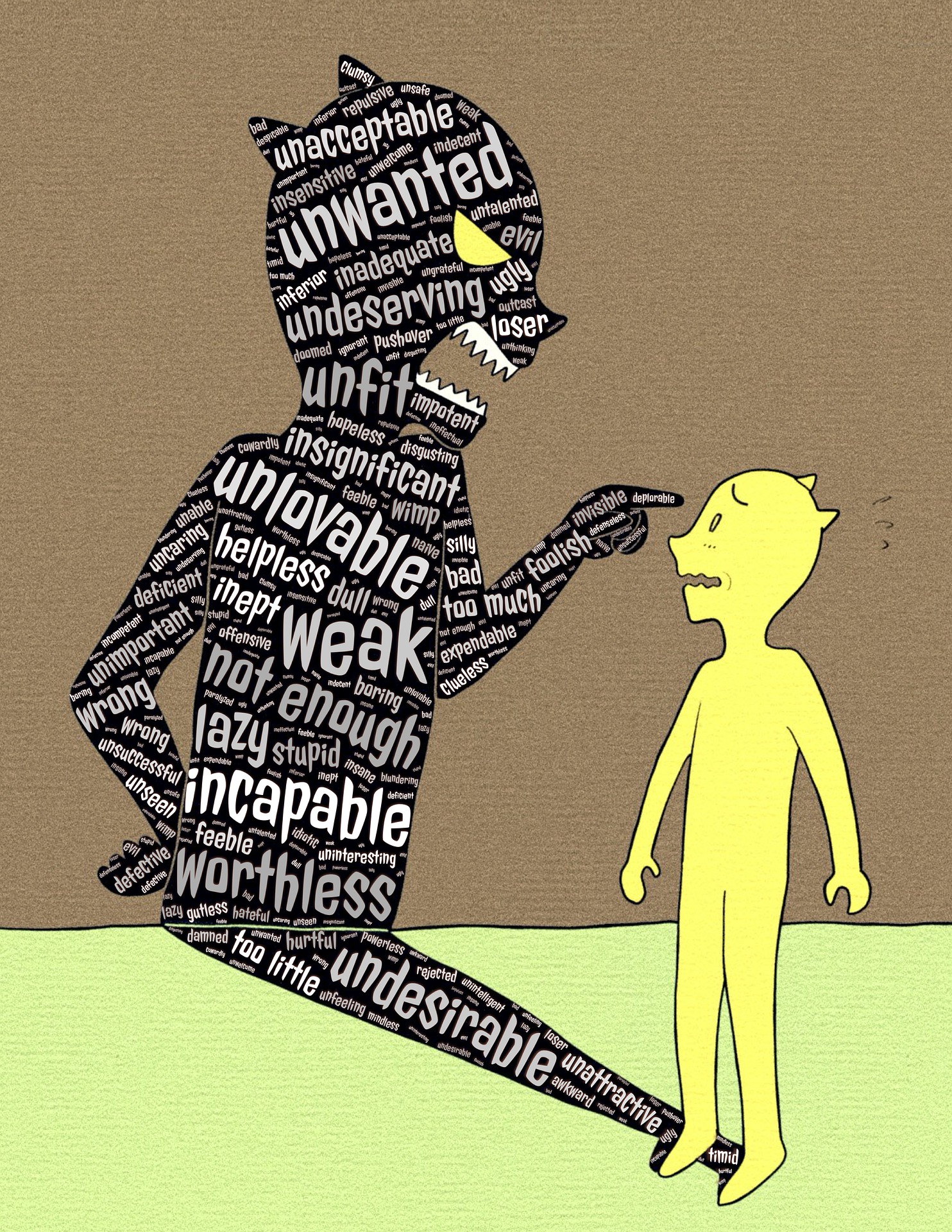
Often we respond to ourselves with a critical voice, and that critical voice prevents us from truly discovering and understanding ourselves. When we allow a safe inner arena within to fully express our thoughts and feelings, allow our inner-counselor to listen and to start asking ourselves open-ended curious questions instead of judging, real solutions emerge because these solutions are not forced or doled out in the pressured sort of way of the critical voice. This understanding and empathy does not mean weakness—in fact from here we can start to safely and reasonably challenge ourselves and our own assumptions.
Overtime, with this inner-counseling approach, I notice that the voices of sadness and anger start to dissipate. I notice that I start to evaluate things more objectively, take things less personally, and at the same time have empathy for myself. The empathy facilitates objectivity, because it allows me a safe inner arena to process my reactions and emotions, allowing me to move more easily into an objective state of mind.
When my critical voice speaks to me harshly, with “must’s,” “ought’s,” and “should’s,” I often believe it is motivating me, but I realized overtime this motivation does not work. I start to become so tense, inflexible, and constrained by its demands that I have trouble seeing possibilities, feeling energetic, and that I lack the freedom and safety I like to have in order to take action. I go instinctively into survival mode, because the critical voice is like a roaming predator.
As stress is released, the scope of what the mind is able to see narrows as it engages in black-and-white thinking. When the mind starts to become authoritarian, we operate more out of a need to avoid making mistakes and avoid failure.
This mindset zaps us of energy, makes it understandably difficult to step forward confidently, and experiment with new approaches. And I have come to realize how normal it is, I and just about everyone experiences this.
The empathetic voice I develop does not try to dominate or push away the judging voice, but empathizes with it as well, and it listens to the judging voice express itself with non-judgment. When the critical voice of my mind speaks, I do not fight fire with fire by being critical towards my critical voice. I tell it “I understand you are frustrated and upset,” speaking to it with empathy.
And that is how the empathy seed in us is planted. It is planted when we can access a part of ourselves that can speak with ourselves with empathy, even to the harsher parts of ourselves. And when those parts feel understood, they soften, then the empathy seed grows into an empathy plant. Its branches reach more and more parts of our brains, and indeed new brain connections supporting empathy start to grow like the branches of a plant.
With empathy, the safe inner arena within us will start to grow, and it provides the support for us to develop the energy, strength, flexibility needed to see new solutions and to take new actions. When the ground is rich in soil and well taken care of and watered, the empathy plant is free to grow naturally. We are then free to explore and experiment with possibilities and options for ourselves confidently and safely, based on our inner compasses, and to start curiously looking towards our paths forward in life—not out of a place of desperation, but out of a place of wanting to. What a pleasant place to be, when we can be kind to ourselves, even towards the parts of ourselves that can be harsh.