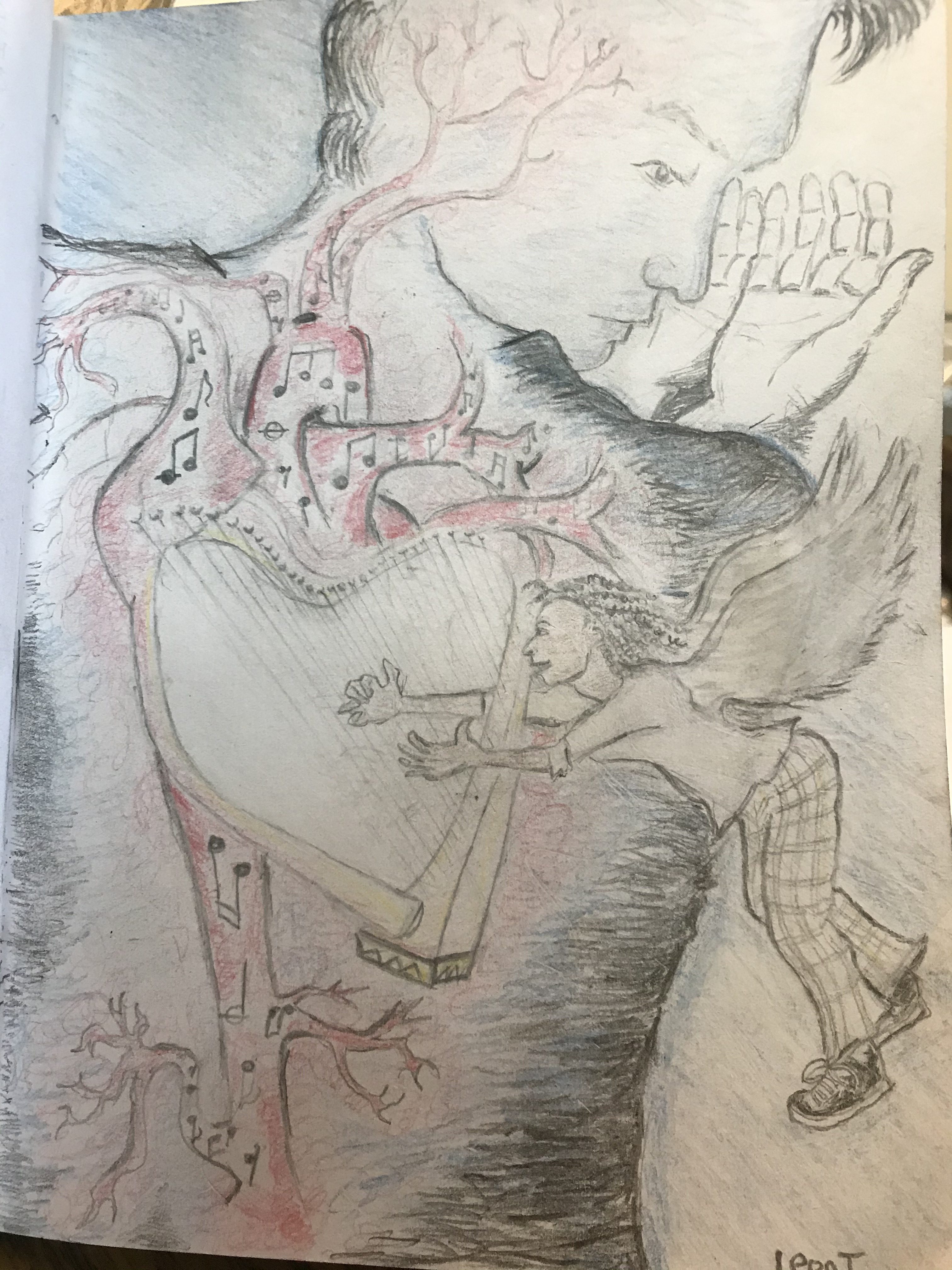
As a child, I had a pure and genuine love for creativity and discovery that had been vanquished by society until I learned, overtime to evolve to become a child again. I am happy to say I had recovered an essential part of myself over the years—my creative self—and I learned the key to stay attuned to it moment to moment, and if I lose it, how to come back into its alignment.
Rediscovering a pure and genuine love for creativity and discovery, I unexpectedly found it to be the most sensible mindset I have cultivated as an adult, more useful than taking life seriously. It is uncomplicated, it has no ulterior motive, and it yet it helped me magnanimously. It caused me to develop an ability to thrive and be resilient in life, better than any drab mentality that tells us that adult life is supposed to be gray, pressured, or complicated. Instead of carrying an unwieldy mindset around that misses the entire point of life, pure creativity and discovery propels me forward into life with an enthusiasm and a joyful penchant for figuring out and understanding the world in a way that ends up being highly practical.
As a child, I treated the world as if I were an explorer and pioneer, and kept various journals on different topics, one of them on my “scientific discoveries and theories.” I believed I was the first discoverer of a number of things that were obviously discovered before. For instance, when I thought I found an undiscovered species of bug on the dining room table of my New Jersey home, I quickly drew it and jotted down its characteristics with intense interest. One may think this is frivolous and even insensible play, and a serious adult would pour cold water on the enterprise, tell me it is just an ordinary bug and to get back to doing something “more real life.” However, this activity gave me an unselfconscious passion for learning that would later serve me for all of my life. It is pure curiosity and interest of what is in front of me, which psychologists call being “in the flow state,” which is optimal for performance and learning.
If I believed like a jaded adult that “everything has been done before,” “life is about a competition of who got there first or who does it the best,” then I would certainly be self-conscious about studying that bug. That self-consciousness would then leak into how I pursue my activities, and over the course of my life, I would begin associating what I do with self-worth and societal judgment, rather than an intrinsic desire to learn and discover. I would begin to proceed through life cautiously in a fail-safe way, rather than with openness and courage. If I continued to believe what the jaded adults say about life, life would lose its luster and I would dismiss creativity and discovery as child’s play. And all this, unfortunately, was exactly what had happened to me—until I learned to recultivate my genuine love for creativity and discovery like a child again.
I was a very creative kid with ADD, and I was often jumping from one thing to another: writing, making art, music, and “inventing music theory” (obviously I did not invent anything new but had so much fun believing I was on the verge of discovering something new). I entered into a children’s invention competition without even realizing it was a competition, because I was so enthusiastic about the idea of making an invention in itself, I was oblivious to the competitive aspect of it. As a result, due to my natural enthusiasm and interest in the problem I was trying to solve with my invention, I impressed the judges and got 2nd place. Next year I entered into the program again, and well-aware it was a competition, my anxiety and pressure around performance was so much that I had a hard time coming up with an invention. Later in my life, comparison with my peers become a greater factor in my life, worsening my anxiety.
It happened when I got into high school. I had a jaded and serious teacher who gave the class a long and grave lecturer that scared me out of my mind. He told us how every single thing we do in school would determine whether we would survive or fail at life, and that we were all in constant competition with one another. Rather than share with us the true spirit of learning, which is to find joy and intrinsic interest in what you do, he twisted into its opposite: to be driven to perform well out of fear. As a result, I decided I should put away all my creative pursuits, and I dedicated myself academically for the sake of “my own long-term survival.”
I stopped writing, making music, and creating because I saw, as the jaded and serious teacher would, that these were frivolous distractions to what makes for a successful life. As someone with ADD, I found myself easily going from one activity and another. I saw this as a fault that kept me from succeeding, and I forced myself sit on my desk to study, study, and study—which felt unnatural to me. I committed to do everything by the book to please the adults in my life, and saw myself through the lens of competition and comparison with my peers, all in the quest to be “sensible”—but to the point that I lost my own soul and my true creative nature. There was no genuine desire for creativity or discovery in the moment, but rather a mind that lacked presence and that kept seeing the grass greener outside of itself and calculating how to get there.
I was considered a good student, but other than that, I did not feel I had the skills for a thriving life. I approached everything cautiously, seeking the most fail-safe plan in my life. I did not express my personality and I just became what other people wanted me to be. I was constantly comparing myself to others in my head. I became what society wanted me to be, but never felt more alienated and isolated. All of this contributed to worsening my social anxiety and generalized anxiety, to the point I had a hard time interacting with the world around me. It was as if I was living in fight-flight-freeze on a constant basis, rather than truly living.
Over time, I slowly rediscovered the value of having pure genuine and intrinsic and what I did, without any other motive rather than to learn, grow, and love what I do. The old way of living, with its complicated and calculated thinking that abstracted me away from living in the present, may seem like the “adult” and “sensible” things to do to achieve success. But I really checked in with myself, and saw simply that I was not truly happy. When I took the leap and gave up on it, I realized I went through the greatest personal growth of my life. When I gave up on others’ perceptions, suddenly it seemed people started to notice real maturity in me. Yes, it involved hard work, but it was with a full focus on a genuine love for learning to grow in itself, rather than fixating on what it would give me in terms of faraway outcomes. It is an energy that is hard to fake, and you will need to genuinely be it and forget how you are perceived.
I notice this even in the little things I do. I was in an obstacle course race, trying to walk across a beam over a large mud pit. The moment I focused on how others were walking faster across their beams, I started losing my balance, but the moment I completely focused on the beam I was on and forgot what others were doing, I was able to center myself, speed up and make it through. Another time, I was badly losing a game of Mahjong, and I was worrying about where I was in comparison to the others and how can I catch up. The moment I completely dropped that self-consciousness was the moment my game greatly improved and I caught up. Every year I wanted the award for Most Hours of Community Service in a civic organization I was part of, and though I pushed hard for it I never got it. It was the year that I gave up on the idea and focused on pure devotion to service that to my total surprise, I received the prize. I see this pattern happen over and over again in my life that I do not think it is a coincidence.
This mentality is not about being against competition. You can be in a competition but you never need to compare yourself to others. Competition is there, but ultimately when you are in one you need to put all your focus on improving your own skills. The moment you take any of that energy away to mentally compare yourself to others, you are losing that focus and your energy and getting distracted from what you are doing. The performance of others is only used to find out how they are learning their skills and using that to better your own, rather than use it to compare yourself as a person to others. It is a subtle but profound difference: one is purely on the objective of learning and the other fixates on “How am I in comparison to others?” One is a grounded energy and the other is an anxious one.
When I can fully live in this space of genuine creativity, discovery, and intrinsic interest in learning, I find I can never be at a loss. It comes without any other motive, such as being better than others, how others perceive me, or societal expectations—motives that cause worry and dissociation from myself. As a result, it brings complete inner peace: I am right where I need to be in terms of the process, not where I should be in terms of outcomes, so I feel fully content. In this space I am in the best position to personally grow and develop because all my mental focus is on where it needs to be in the moment, rather than on calculating the gap between where I am and where I ought to be. In this space there is no cloudy judgment, just a real inward attunement with how my soul wants me to grow without the contamination of external expectations.
As I am becoming a writer, a valuable realization has helped me to keep on writing: there is a difference between a person who wants to be a somebody in the eyes of others, and a person who wants to share their message for others. Their actions can appear quite similar on the outside, each promoting and sharing their work—however, on the inside, there is a stark contrast. The person focused on being a somebody has an ongoing hole to fill, as their ultimate aim is to be relevant, and so their motivation dies when they don’t feel relevant. They make content focused more on their relevance rather than on a real message. The person focused on sharing their message does not have an inner hole because they are interested in the message in itself: they are simply the messenger, and their own relevance is not the aim. Their motivation never dies because they are focused on the process of delivering the message and on relating their message to others. Interested in something bigger than themselves, they are not caught up in their relevance.