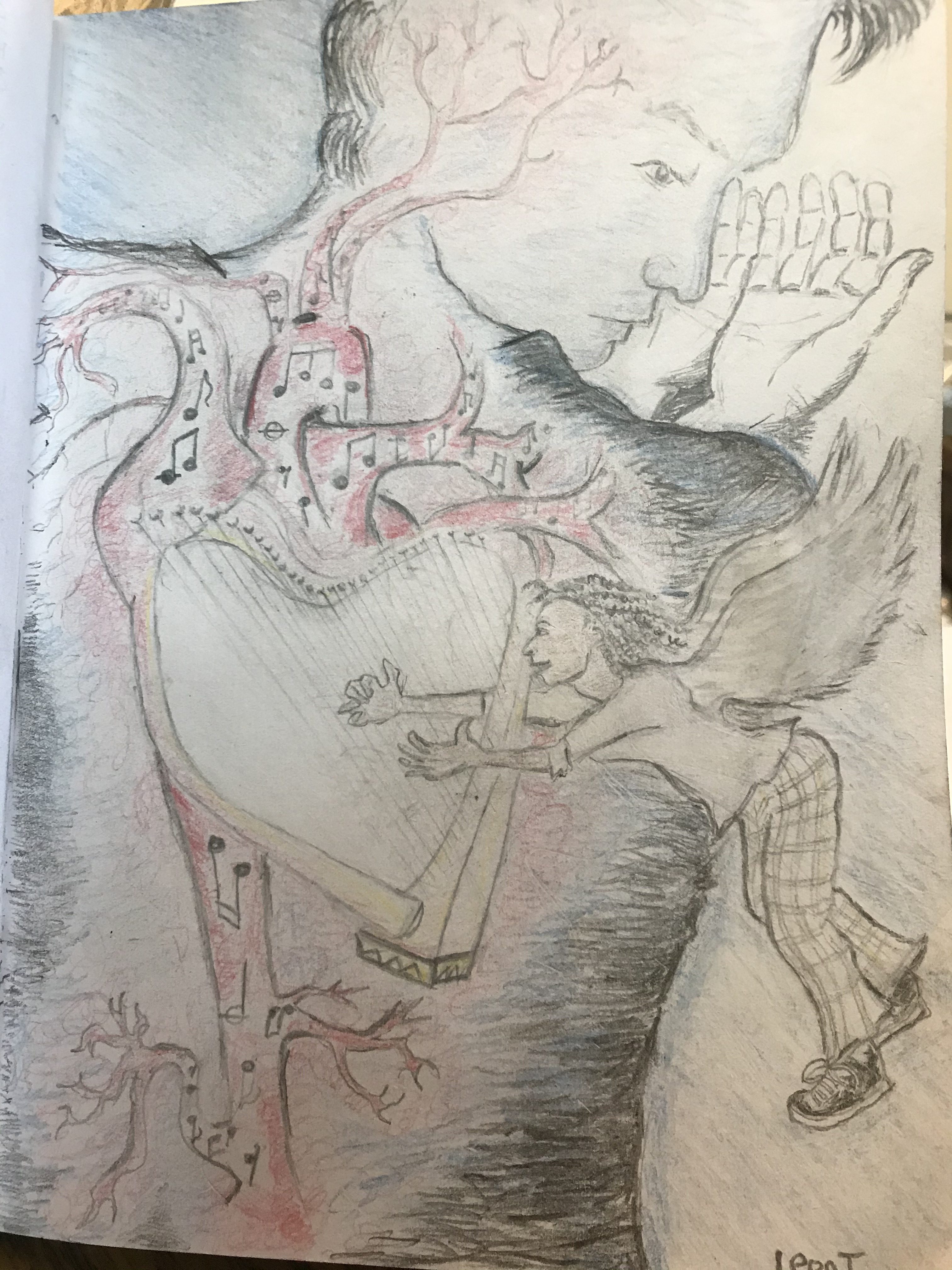
Sometimes when our emotions are particularly difficult, we find there seems to be no way to get out of them. We have fallen deep into their craggily cave, and we are doing our best to climb the ladder out of it—only the ladder seems to keep extending before us to nowhere, into further darkness.
Here, despite all our determination to get out, a defeated feeling crawls in and whispers in our ear, “I’m hopeless.” It can understandably feel like a shameful place to be. Why can’t we just get out? Why can’t we just stop listening to the negative emotions within?
We try to tell ourselves: “Just snap out of it, just change these thoughts…” again and again, and it does not seem to be working this time. We may have been able to snap out of them before, but why can’t we do it this time? We were able to navigate the dark cave of emotions before with our light of reason in our hands—but now it seems our light has gone out.
When things gotten low like this, there seems to be for us no way. The way forward, and even the way around, are options that have been exhausted. There is no way to move to—not for now.
I have been in a dark space like this, deep in my craggily cave. Usually I am able to put things into perspective and be constructive with my thoughts. However, let me be earnest with you—I anticipate that just like every other human being, I will sink into my deep, dark cave of emotions again and again. I anticipate it to be cold, stifling, ugly, and painful.
Yet, at the same time, I anticipate that I will make it through, and that I will be okay. I have survived before, and I will survive again. I also know, it is all a normal human experience. But honestly, in a midst of a difficult storm of emotions, I can find such supportive words of “making it through” and “being okay” difficult to believe. They are only fully believable after the storm has passed. I realize that during the storm, I do not have to force myself to believe them.
When believing is too much, it is enough to allow for these words to be there, and know of their presence and truth, without having to force myself to believe in them fully. It is enough to have them standing by in the back of my mind.
With the permission of these words, I no longer resist, I no longer struggle, and I allow myself to sink deeper into my craggily cave. Yes, I allow the difficult emotions and thoughts to be as difficult as they want to be. It is courageous at times to fight, yet it also can be courageous at other times to let things be.
What is different this time, though, is that when I let my emotions and thoughts be, I do so as a conscious choice. I consciously let go and release myself deep into them, with my own permission. I release myself into the pain, but within a consciously chosen, safe container. I put away my work, I shut the door of my bedroom. I may be in my bed and I do not force myself to do anything. I may listen to music, read, or simply do nothing.
There are times when it seems like your emotions are at odds with your reason. Rationally, you know “the right” thing to do, but your emotions fight you every step of the way. You believe you are “supposed to” follow your reason, but each step you take forward towards reason seems to leave you wading deeper in the frigid waters of difficult emotions.
There is certainly a place for rationality, but there are times when emotions have their own odd, but equally legitimate reason. It is not a straightforward kind of reason. They draw you unwillingly down a dark and winding path. And when we stop resisting them, and let them take us where they want us to go, however frightening, they take us through an unusual healing process. A healing that cannot be directed by us in any way, but one that must take its own course.
But when we go down this path, we can remember to do it within a “safe container”—by knowing in the way back of our minds that we will be okay and we will survive. We can remember to do it by a conscious choice to stop resisting, and follow the lead of our emotions as we ride them out.
And each time, when I come back to the dark space of my craggily cave, it is always a hard and challenging experience. But each time I come back, I do so more and more consciously and with awareness. I do so with a deeper knowing of its part of the human experience.
I wish too that enlightenment can go in a straight line, and once we reach its destination, we can stay there. But perhaps it winds to and fro, between rationality and emotion, between the transcendent and the shadow within us, between going forward in life and sinking inwards into our pain, over and over again—like a spiral. And yet the lows are as meaningful and integral part of it as are the highs, when we step back to take the birds-eye view of our lives.
The winding line of a spiral within a seashell goes further from its center before winding back towards it, only to go away from the center, before winding back towards it again. Is each wind away a wrong turn, or what bring us closer towards the center? And is the center all that matters, or do the spirals themselves really make the beautiful seashell what it is?