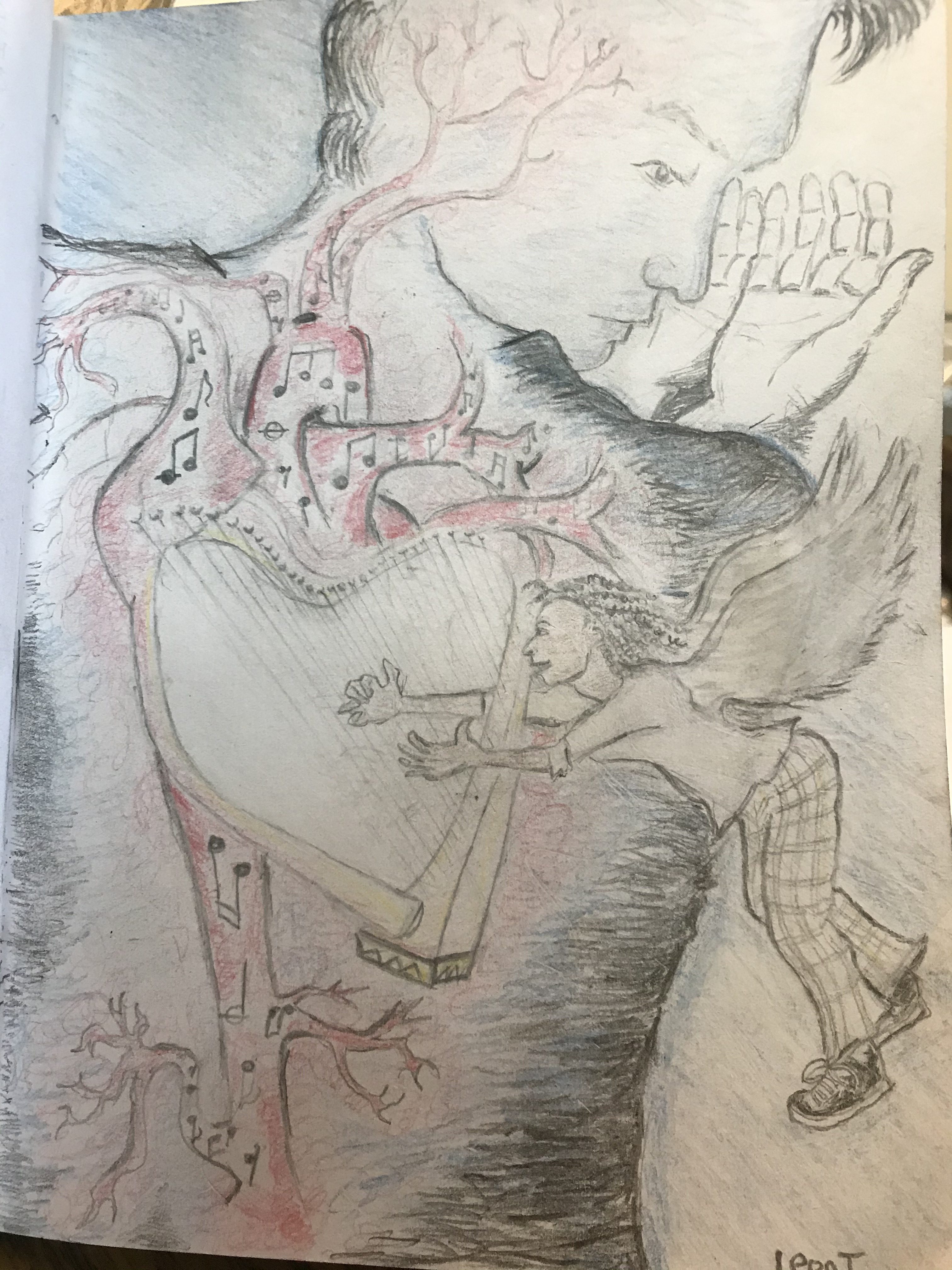
There are two essential ingredients to empathy: Feeling and Thinking. Empathy does not come from Feeling alone. Neither is Empathy a compromise between Thinking and Feeling, but rather the union of both to create something greater than either of them can produce alone. I capitalize these words Thinking and Feeling because I am referring to the tendencies of “Feeling and Thinking Types” according to Carl Jung’s personality typing system, and both types will have both tendencies but each type will favor one, hence the names of the types.
Traditionally, Feeling is seen as the essential factor in empathy. There is good reason for this, and perhaps it creates an initial advantage, though in my experience Feeling and Thinking Types of equal higher level of maturity tend to be of equally sophisticated empathy.
The reason for this is that empathy involves seemingly contradictory and polar abilities: on the one hand, an ability to feel-with the other, a viscerally-experienced valuing of another’s inner world that cannot be limited to technical description (a.k.a. Feeling), and on the other, an ability for objective understanding of the other from a standpoint of mindful detachment that is free of personalization (a.k.a. Thinking).
Yet despite such contrasting and opposing differences of Thinking and Feeling on the surface, in Empathy, they synchronize together seamlessly. One furthers and supports the aim of the other, rather than compromises or detracts from the other.
Without Thinking, Feeling becomes unsympathetic due to the lack of a true objective understanding of the other person—and as a result, it contradicts its own aim. It feels, but it becomes a fantastical feeling unrelated to another’s actual human experience. It is inauthentic at the core, even as cold and apathetic as an unrealized form of Thinking. This is because without Thinking, the valuations that Feeling makes of another’s world merely become projections.
The objective understanding of Thinking complements the raw internal experience of Feeling for another’s condition with a level-headed understanding, a clear knowledge and discernment of that condition. This allows Feeling to become authentic. Instead of stifling Feeling, the mindful detachment of Thinking works simultaneously alongside of it. It helps Feeling to become more fully realized, mapping out another’s world for it with accuracy, thus giving Feeling more and more awareness of what it could truly internally experience for another while preventing it from devolving into over-personalized projection.
Without Feeling, Thinking becomes inaccurate due to the lack of a genuine desire to experience the world the other person—and as a result, it contradicts its own aim. It thinks, but it becomes a false kind of thinking unrelated to reality. It is dishonest in its foundations, even as biased and impractical as an unrealized form of Feeling. This is because without Feeling, the discernments that Thinking makes of another’s world merely become pretentious intellectualizations.
The raw internal experiencing of Feeling for another’s condition complements Thinking. Without it, the understanding of Thinking cannot be objective, because the internal world cannot be fully explicated by words, concepts, and delineations. It allows Thinking to keep itself honest. Instead of suppressing Thinking, the experience of Feeling works simultaneously alongside of it. It helps Thinking to become more fully realized, allowing its thoughts to relate back to the human condition as it is organically experienced, thus giving Thinking more and more awareness of its own usefulness and service to others and to itself, preventing it from disconnecting into a world of apathy and unrelatedness.
At a lower level of personal growth, self-individuation, and awareness, Thinking and Feeling view each other with a sense of otherness, and thus have an instinctive reflex to suppress its opposite. However, suppression only makes the opposite stronger. What happens is that, paradoxically, unrealized Feeling and unrealized Thinking end up working together in unhealthy, unconscious ways. Unrealized Thinking develops an intense irrational fear and hateful scorn for Feeling—possessing all the negative sentimental expressions of unrealized Feeling. Unrealized Feeling develops a cold dismissiveness and lack of sympathy towards the value of Thinking—possessing all the attributes of the negative calculus and callousness of unrealized Thinking.
This is an understandable initial reflex of both Feeling and Thinking Types, as the other literally possesses the opposite definition, and so there is competition. The competition is felt against the opposite type, as well as within oneself. Tension between the opposites is felt within one person, even in an individuated one.
It is what one does with the tension that determines personal growth and self-individuation. A person on the path towards self-individuation processes the tension within with mindful detachment and compassionate awareness. They practice empathy with their own inner conflict. They seek to unite the opposites into a whole, bringing Thinking and Feeling together to generate a fully realized, authentic and honest form of Empathy. They treat it as an ongoing process, and practice directing this empathy towards themselves and towards others.