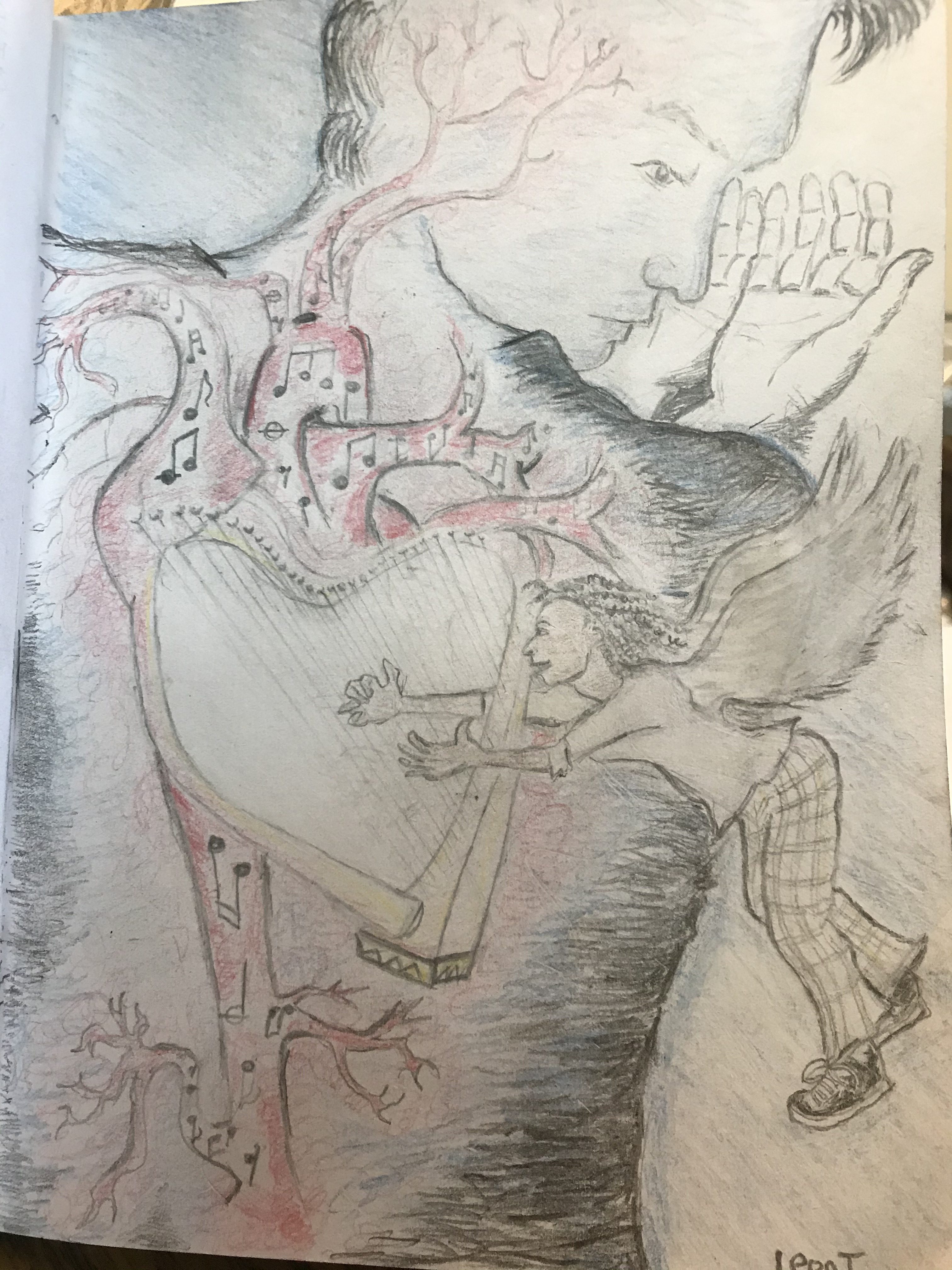
People were fairly amused for my inability to produce words adequately and fluidly. I remember back when I was in high school that we were to give presentations in class, and my voice shook and stammered as I spoke in a whisper and in a sensitive manner, as if any word would set off a bomb. As the class grew quiet and awkward, I observed how the class mischief was having quite a good time, smirking away.
I remember back when I was in college, a professor put me on the spot to explain a concept we learned. To say that I was bad at explaining things is an understatement; whenever I tried to explain anything, I was utterly incoherent. My brain froze and I knew I was doomed, but nevertheless I went forth with a pitiful attempt. It sent this girl laughing indignantly as I muttered my way through my “explanation,” unable to string sentences together. Through high school and college, anxious even when I talked to one stranger or acquaintance in front of me, I developed the habit of digging my nails into my hand behind my back while talking to them in order to alleviate the pain of social anxiety.
When you look at the title of this piece you may believe that I am going to tell you how I had slowly grown out of my anxiety and inability to speak, but this was no gradual journey of progression. I dreamed in my childhood that I would grow out of my social anxiety, but into adulthood it actually became more severe. I had gained a reputation for it. I remember as I stood on a porch as the neighbors playfully teased about the way I talked. When my friends from college came all the way from New York to Georgia to come visit me for a week, I barely spoke the whole time, and they noticed the sharp drop in my ability to speak.
My life had been marred by Social Anxiety Disorder. I had a fear of even leaving my house, and when I did, when I saw someone approach on the other side of the sidewalk I was walking on, I would switch over to the other sidewalk. I had a fear of going up to cashiers of any store, and if I bought something I would start sweating profusely and hesitate before walking up to them. It was isolating being around the other boys as they purposefully exclude you because they cannot withstand your silence. At a camp I remembered they would form a circle and talk while they left me behind. I had a fear of going to work, because I would feel so nervous and hypersensitive to the work environment that I would become awfully clumsy and forgetful, and my bosses would disapprove of me, which would only exacerbate my fear.
As I turned 26, it only got worse. I could not take it anymore how much my social anxiety deprived me, and it would only seem to take more away from me. In graduate school, I lived an isolated life because I was busy all the time, working and going to school 12 hours a day, and thus I was unable to form social connections. When there were less connections, the social anxiety tended to increase manifold, which is a pattern I noticed in my life. The symptoms became unrelenting as I felt a tense, clenching pain develop around my throat, jaw, and tongue due to fear of speaking. During graduate and social functions, I would hide in the restroom as my heart thumped wildly and sweat would stream all over me.
It came to a point where one night in my room I just lashed out at the universe about the nightmare it created that I could not take anymore. I spent all my life patiently coming up with adaptations and coping mechanisms for my condition, slowly chipping away at an iceberg of Social Anxiety armed with a windshield scraper. To tease my efforts, the universe decided to make the iceberg even larger. Then after cursing it all night I thought I could send it a prayer to help me. Praying was something I simply did not do, but it was all I was able to come up with because I felt desperate.
That night I had a dream that felt so real. A stream of rainfall came down from the sky, and it powerfully splattered into my throat—right into my vocal cords, the same sensation you would get standing under heavy, pouring rain. This energetic force just pounded away at my throat and then spread from there throughout my body. When I woke up, my problems were all still there, but I felt a persevering sense of hope.
This made me decide to do something I thought was impossible, and I had trouble forgiving myself for doing: I decided to apply to do a TEDx Talk. To this day I did not know what drove me, and I remember chastising myself for being insane enough to take such a drastic measure to combat my social anxiety. Maybe I should had been inspired to go to a therapist after that dream, but no, I had to apply to talk in front of hundreds of people. My application was accepted, and I entered into the speech competition phase. Every day preparing for that speech was more nightmarish than my life before TEDx entered into my life. I tried to memorize my lines as my mouth felt like it was twisting and squirming about in protest because of the pain it felt, but nevertheless the dream still pushed me madly into this seemingly disastrous idea.
I did not succeed in the competition, perhaps because I was obviously awkward to the judges, but the year since I grew much more self-confident. I started to talk with others with greater ease and smoothness, though I was still shy. I applied to do TEDx again. I was much less nervous preparing for the competition phase this time and I passed it. Then it hit me: I was going to speak in front of 800 people. I was going to do something that even a social butterfly who hosts parties would rather wish for death over: public speaking.
I felt nervous for sure, but at the same time I was confident. On March 2015, I got in front of 800 people (and more, since I was live-streamed) and gave my talk about how Eastern and Western cultural perspectives on creativity contrast with one another. I remembered getting into the zone when I was on stage, and then in the middle of the speech I woke up a bit and started to think of my situation from a meta-perspective: I am the man who cannot speak who is giving a speech.
Today that speech has opened the door for me to continue doing stuff that would seem impossible to my former self, which I would never would have even thought of doing because they seemed unfathomable given the condition I had. I always thought I was going to live a relatively quiet life on the sidelines.
My life became greater than my fantasies. I came to organize Meetup groups in the New York City area, initiate social outings, and own YouTube Channels in which I talk about mental health and about personality types. I continue to be a speaker, giving workshops, and I work as a therapist and life coach.
To fully understand the theme of human connection, unlike many others, I had to start from the very bottom. I had to experience how it was like to feel complete powerlessness and be deprived of any ability to connect. I think back to my lashing out at the universe and then coming back to it, asking for its assistance as if I were in a tragi-comical relationship, and I knew why what happened to me happened.
This journey I had taken was a painful one, but in turn the pain turned into a beautiful story for my life that I will never take back, even if I were tantalized by a genie with the option of going back in time so that I can at least be socially average. This terrible sense of lack of connection in my life allowed me to be appreciative of a true understanding of what it means to connect with others because I had to struggle with it even at the most basic level. And for that, I think the universe made my life into a meaningful artwork.
This article is a sample of my book DIARY OF AN IMPERFECTIST. Get my FULL BOOK HERE